Retirement Portfolio Resilience Perspective
Primary Pillar: Sequencing Risk Awareness
Supporting Pillars: Retirement Portfolio Construction • Behavioural Survivability
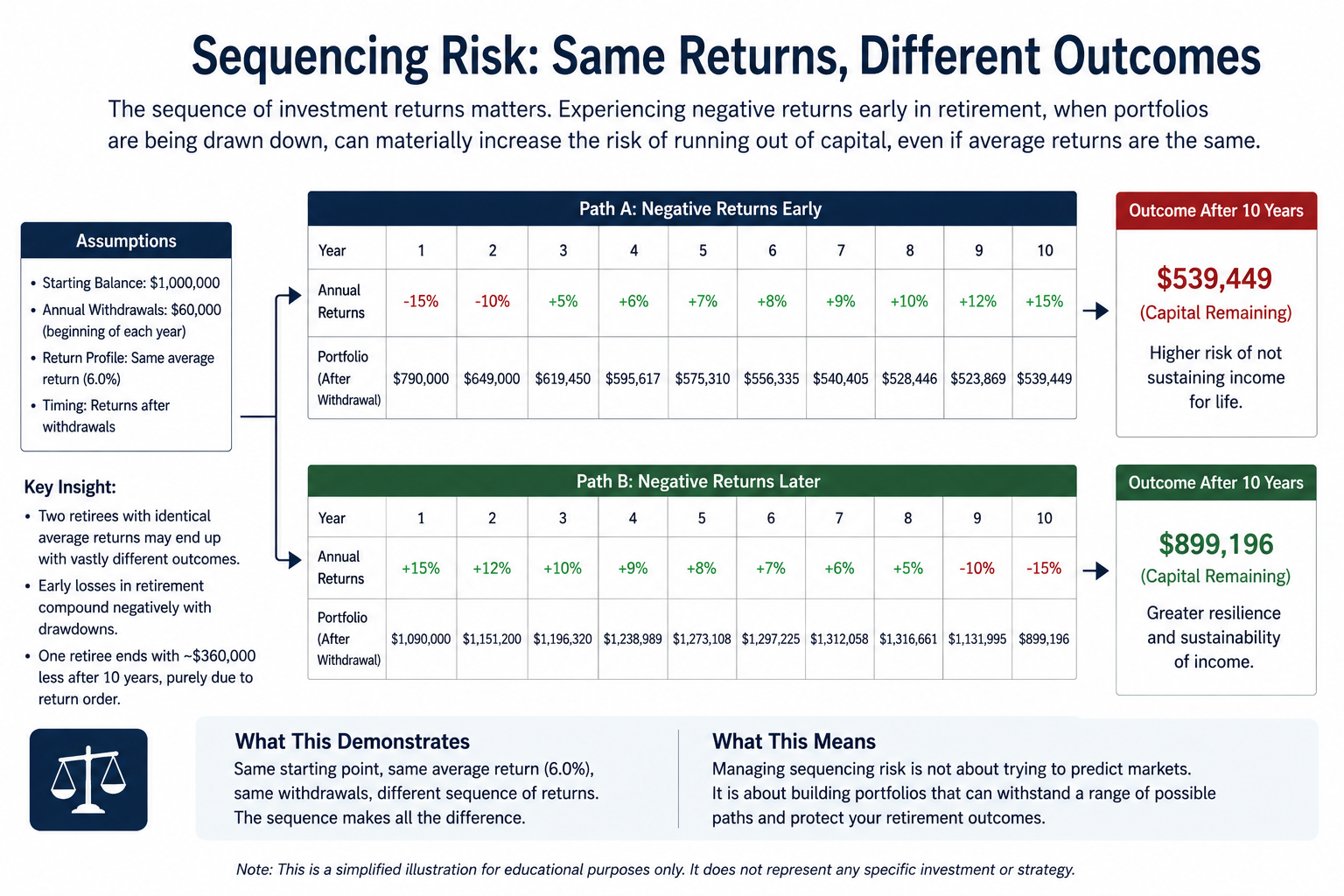
This article examines one of the most important yet often overlooked risks facing retirement investors: sequencing risk. It explains why the order in which investment returns occur can materially influence retirement outcomes, even when long-term average returns are identical.
The article explores why most retirement portfolios rely on diversification, asset allocation and time to recover from market declines, yet often do not explicitly address the consequences of major drawdowns early in retirement. It highlights the distinction between recognising sequencing risk and designing portfolios that seek to reduce its impact through Retirement Portfolio Resilience.
This article forms part of a broader body of research, educational articles and practical insights organised through the Retirement Portfolio Resilience Framework.
Most portfolios are built on a simple assumption: that equity risk will be rewarded over time. While this has generally proven true, it overlooks a critical factor — the path of returns.
For investors in or approaching retirement, the sequence in which returns occur can have a lasting impact on outcomes. Early losses, combined with ongoing withdrawals, can permanently impair the capital base. This is known as sequence risk.
Despite its importance, most portfolios do not explicitly manage this risk. Instead, they rely on diversification, asset allocation and time to recover from market declines. In practice, this often leaves portfolios fully exposed during periods of drawdown.
This creates a structural gap in portfolio construction — one where downside risk is endured rather than actively managed.
For advisers working with retirement-focused clients, this distinction is important. Managing the path of returns, not just the long-term average, can materially influence both outcomes and investor behaviour.