Retirement Portfolio Resilience Perspective
Primary Pillar: Behavioural Survivability
Supporting Pillars: Sequencing Risk Awareness • Retirement Portfolio Construction
This article examines how investor behaviour changes as retirement approaches and why effective Retirement Portfolio Resilience must address both financial and behavioural risk.
It explores the point at which the natural protections of accumulation—ongoing contributions, long investment horizons and the ability to recover from market declines—begin to diminish. As investors transition into retirement, sequencing risk and loss aversion become increasingly significant, making portfolio construction just as important as behavioural coaching. The article explains why resilient retirement portfolios should be designed to help investors remain financially and emotionally invested throughout their retirement journey, regardless of the path markets take.
This article forms part of a broader body of research, educational articles and practical insights organised through the Retirement Portfolio Resilience Framework.
The Behavioural Crossover: Why risk management fades when we need it most
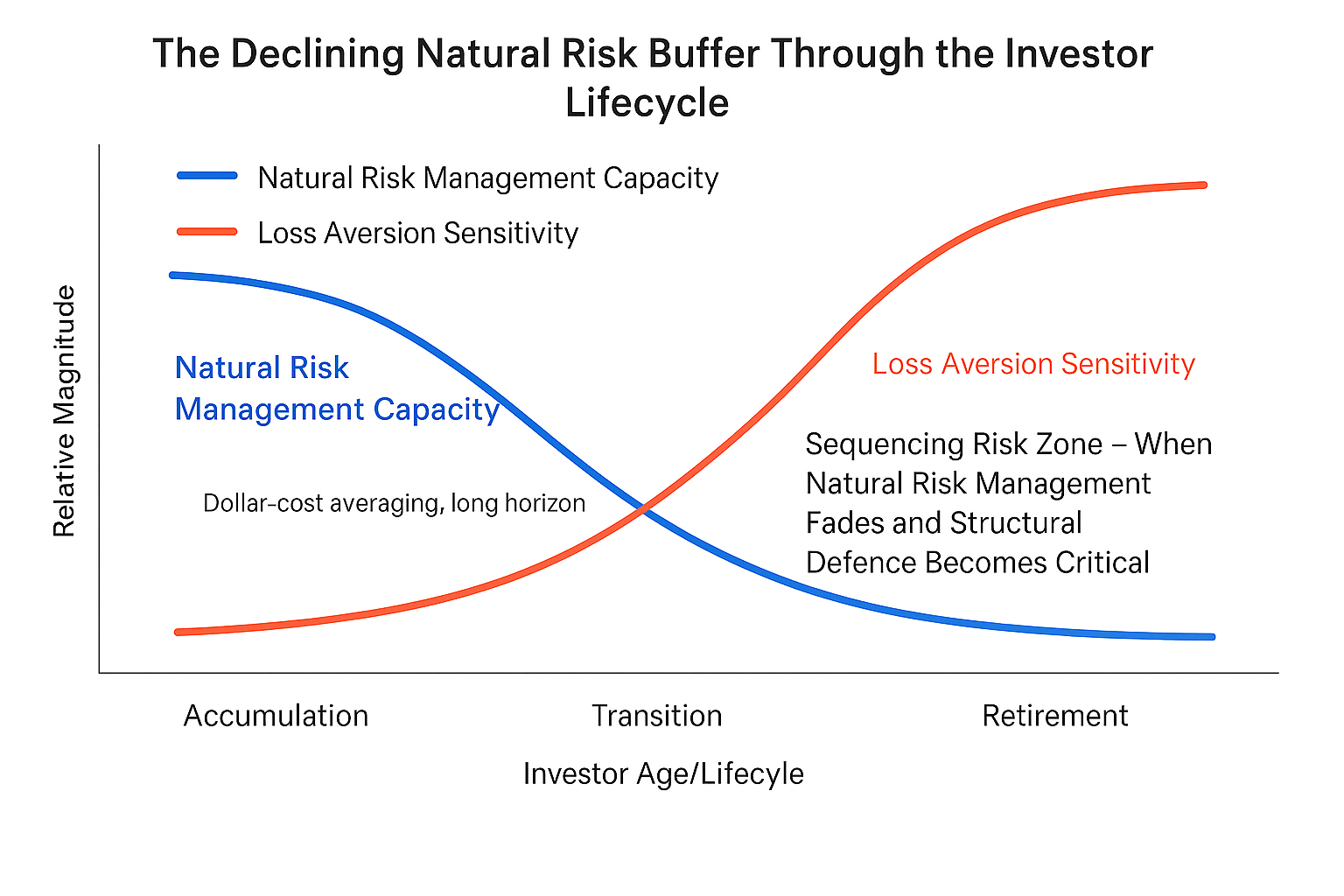
As investors transition to retirement, the financial and psychological equations invert:
• Contributions stop; withdrawals begin. There is no new capital to average down losses.
• The portfolio is now finite. Investors frame wealth not as future opportunity, but as lifetime security.
• Loss aversion peaks. A 10% decline in retirement feels catastrophic because it directly threatens lifestyle sustainability
This shift transforms volatility from friend to foe. The same 10% drawdown that was tolerable at 40 years old becomes intolerable at 65, not because of numbers, but because of context.
This is where sequencing risk emerges: losses early in retirement inflict damage that time and income cannot easily repair.
Advisers now face a paradox: encouraging patience no longer works because patience is no longer protective. The solution must therefore move from behavioural coaching to structural risk design.