November Retirement Portfolio Resilience Assessment
Markets have risen. Protection costs have fallen. Retirement confidence still matters.
By Craig Racine – Managing Director & CIO, Gyrostat Capital Management
Retirement Portfolio Resilience Pillars
Primary Pillar: Risk Pricing Discipline
Related Pillars: Sequencing Risk Awareness · Behavioural Survivability · Retirement Portfolio Construction · Resilience Across Market Environments
Each month, the Retirement Portfolio Resilience Assessment examines observable market conditions and their implications for prudent retirement portfolio construction.
Retirement investing presents a different challenge from wealth accumulation. Contributions generally cease, withdrawals continue, and the sequence of investment returns can materially affect long-term outcomes.
This month's assessment asks:
Does the retirement portfolio provide the resilience and confidence needed for retirees not only to remain invested, but also to enjoy the retirement they have worked to fund?
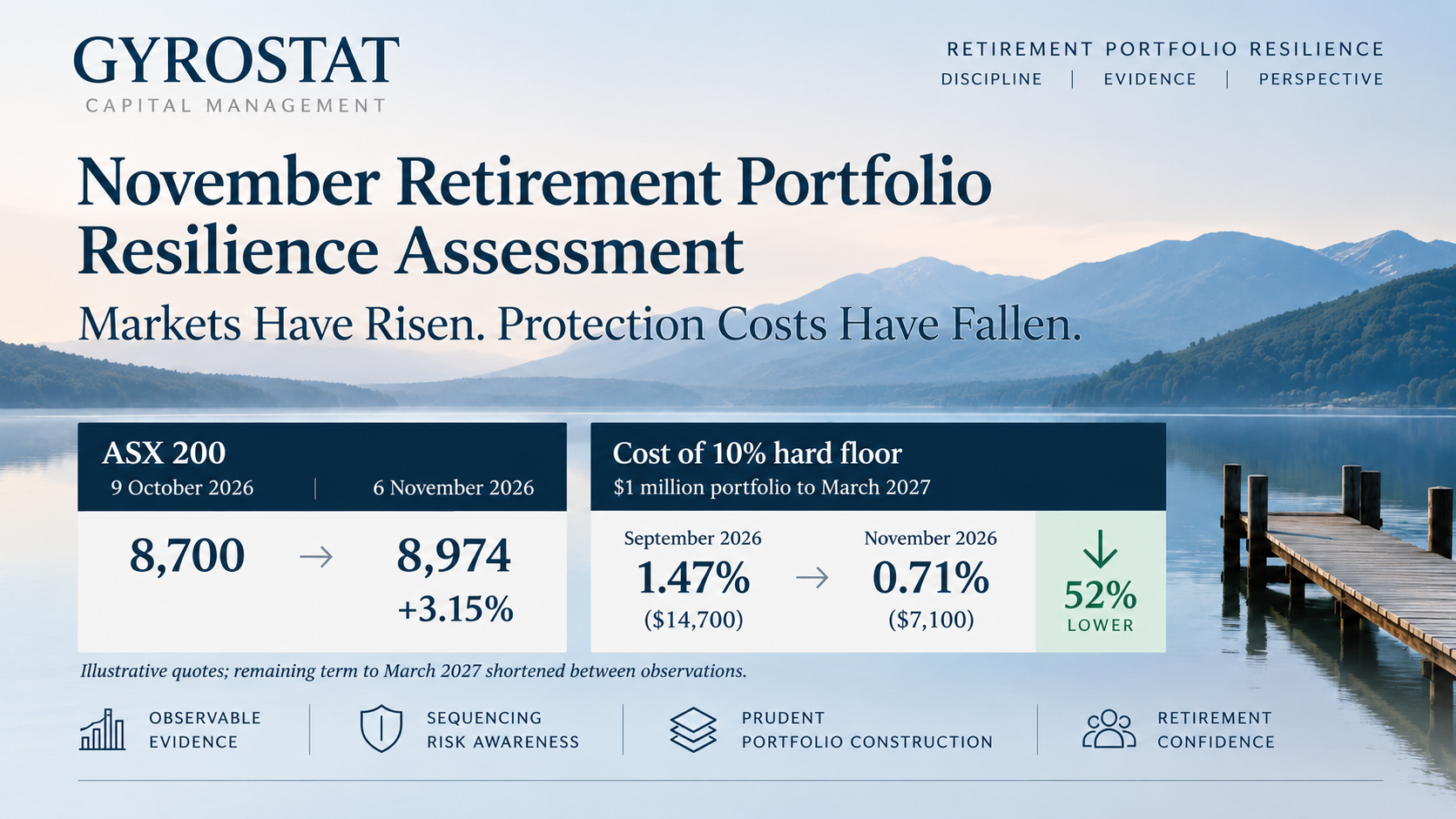
At 6 November 2026, the ASX 200 was approximately 8,974, compared with approximately 8,700 at the time of our October assessment — an increase of approximately 3.15%.
Over the same period, the quoted cost of establishing downside protection to March 2027 fell further.
For a $1 million portfolio, the illustrative cost of establishing a 10% hard floor declined from approximately $14,700 (1.47%) in September to $9,000 (0.90%) in October and $7,100 (0.71%) in November — approximately 52% below September.
These comparisons reflect both changes in option prices and the shortening period to the same March 2027 expiry. They should not be interpreted as a pure measure of changing market volatility.
Markets have risen. The quoted cost of protection has fallen further. But the consequences of an adverse market path remain.
The purpose is not to predict the next market decline. It is to recognise that sequencing risk and behavioural risk remain relevant even when markets are rising.
For retirees, behavioural survivability has two dimensions: remaining invested through adverse markets and having sufficient confidence, within a sustainable financial plan, to enjoy retirement rather than continually postponing valued experiences through fear of future losses.
The November assessment also examines the four complementary functions of retirement portfolios — Growth, Defensive, Retirement Income and Retirement Portfolio Resilience — and presents historical evidence for assessing resilience through a dedicated 5% RPR Unit.
The stewardship principle is straightforward: design resilience before adverse conditions make its value obvious.
Read the full November Retirement Portfolio Resilience Assessment in the PDF below.
Explore the Gyrostat Knowledge Centre for the Retirement Portfolio Resilience Framework, adviser resources and ongoing research.