Retirement Portfolio Resilience Perspective
Primary Pillar: Retirement Portfolio Construction
Supporting Pillars: Risk Pricing Discipline • Behavioural Survivability
This article examines how portfolio structure can help investors navigate uncertainty through diversified non-correlated assets, embedded downside protection and disciplined portfolio construction.
Drawing on behavioural finance and decision-making under uncertainty, the article explains why resilient portfolio structures should be designed to perform across a wide range of possible future outcomes rather than rely on accurate market prediction. Although written before the Retirement Portfolio Resilience Framework was formally articulated, it establishes many of the enduring principles that would later define Gyrostat's philosophy of helping investors remain financially and emotionally invested throughout their retirement journey, regardless of the path markets take.
This article forms part of a broader body of research, educational articles and practical insights organised through the Retirement Portfolio Resilience Framework.
Many investors, particularly retiree investors, want to preserve the lifestyle that they have. They want to take back control and maintain their self reliance in the face of a highly uncertain world.
Nobel Laureate in Economics Daniel Kahneman draws together his lifetime of research in “Thinking, fast and slow”. He challenges the rationale model of judgment and decision making and incorporates psychology to optimise structures to improve the outcomes for humans – to deliver what they really want.
Kahneman observed “When they made decisions, people did not seek to maximize utility. They sought to minimize regret.”
Portfolio structure to help investors address uncertainty
An approach that has been well recognised to work for all market conditions is to construct a portfolio with diversified non-correlated assets.
How to deal with uncertainty? Base rate scenario planning asset allocation
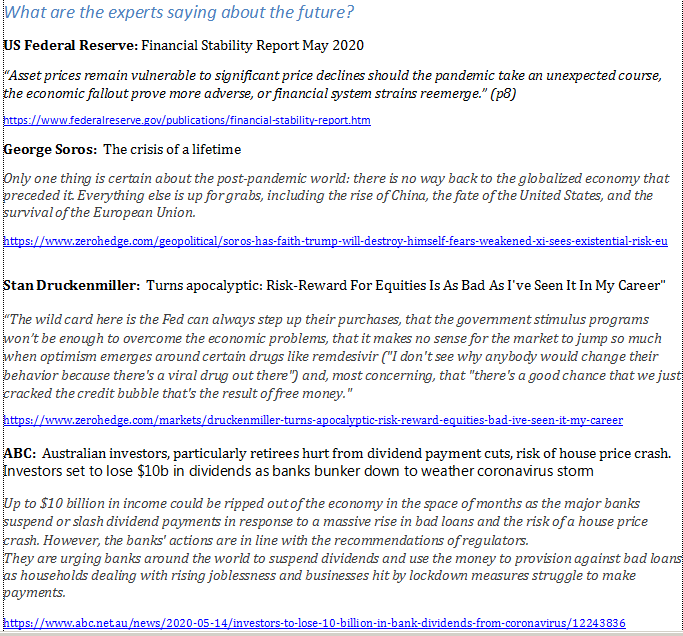
In a world of such uncertainty, Kahneman and Tversky suggest that you start with a ‘base’ rate. Ie: What would you predict if you had no information at all.
The base rate is that stock markets will re-test previous falls.
“… in 19 of 19 post-war instances of a 15% uninterrupted decline (excluding the current one), the stock market ended up re-testing the waterfall low in some fashion. Basically, markets tend to rally after “waterfall” declines. Until recently, test case #20 (Q4 2018) was the outlier. That low has now been re-tested.”