Retirement Portfolio Resilience Perspective
Primary Pillar: Retirement Portfolio Construction
Supporting Pillars: Behavioural Survivability • Risk Pricing Discipline
This foundational thought piece considers the role that protected exposure to growth assets can play within retirement portfolios and broader retirement income solutions.
Viewed through today's Retirement Portfolio Resilience Framework, the enduring contribution of this publication is that it does not present equity-protected investing as a complete retirement solution. Instead, it recognises that retirement portfolios require complementary functions—including income generation, growth participation and disciplined risk management—and explores how resilient exposure to growth assets can contribute to that broader objective. While the discussion reflects the policy and market environment of 2016, the underlying architectural principle of combining complementary portfolio functions remains central to the evolution of Retirement Portfolio Resilience.
This publication forms part of Gyrostat's constitutional archive documenting the evolution of the Retirement Portfolio Resilience Framework.
Executive summary
- Investors require adequate income whilst protecting and growing capital
- Today’s investment challenges
- A framework to review retirement income products
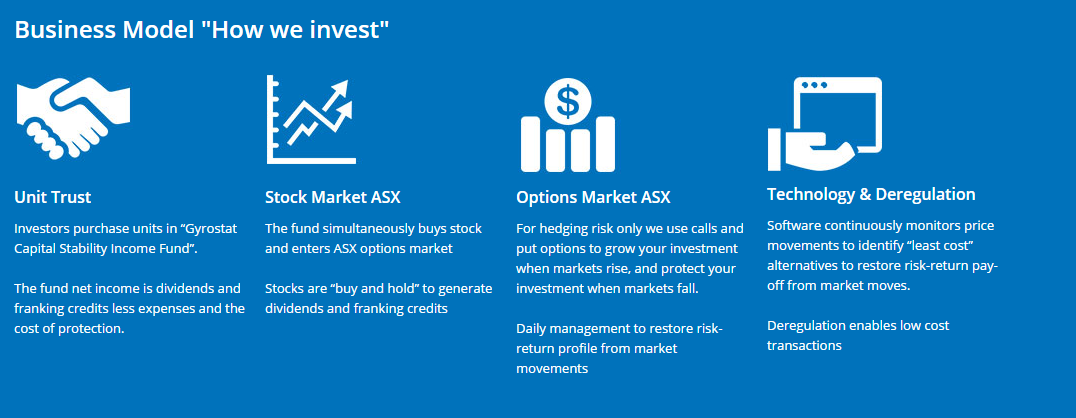
- A solution: buy blue chip high yielding shares for income, with insurance
The Federal Government is committed to facilitate better retirement income products.
“We want to facilitate better retirement products that allow retirees to improve their standards of living”, Assistant Treasurer Kelly O’Dwyer stated recently when addressing the Committee for Economic Development of Australia.
“… the retirement phase of superannuation is underdeveloped and provides limited choice for managing risk”
David Murray, Chair of The Financial System Inquiry
The Financial System Inquiry listed 3 criteria for “comprehensive retirement income products.”
- Regular and stable income
- Longevity: invest in growth assets
- Flexibility: low cost, ‘cooling off’ period
The Lonsec report referred to above considers the asset classes commonly used to generate retirement income:
· Term deposits
· Annuities
· Endowment Bonds
· Bond funds
· Equities – income focused
· Hybrids
Most “income” alternatives don’t invest in growth assets.
The perception has been historically that having protection always in place is ‘expensive’. Active management of the ASX options is the key to lowering its cost. This is enabled by developments in technology and deregulation.