Retirement Portfolio Resilience Perspective
Primary Pillar: Retirement Portfolio Construction
Supporting Pillars: Resilience Across Market Environments • Risk Pricing Discipline
This article examines how the design of a portfolio can itself become a source of risk if it relies on assumptions that only hold under favourable market conditions.
Rather than focusing on individual market events, the article explores the underlying architecture of investment decisions and how assumptions about diversification, liquidity, correlations and investor behaviour influence long-term outcomes. It explains why Retirement Portfolio Resilience is achieved not by attempting to predict future shocks, but by constructing portfolios capable of remaining effective across a broad range of market environments.
This article forms part of a broader body of research, educational articles and practical insights organised through the Retirement Portfolio Resilience Framework.
In portfolio construction, risk is rarely where we look for it. More often, it hides in the architecture — the assumptions, incentives, and mental shortcuts that quietly shape our decisions. Nassim Taleb and Daniel Kahneman, from very different disciplines, converge on this point: the true source of fragility is structural. Markets, portfolios, and even adviser–client relationships can appear stable for years, until the design itself is tested.
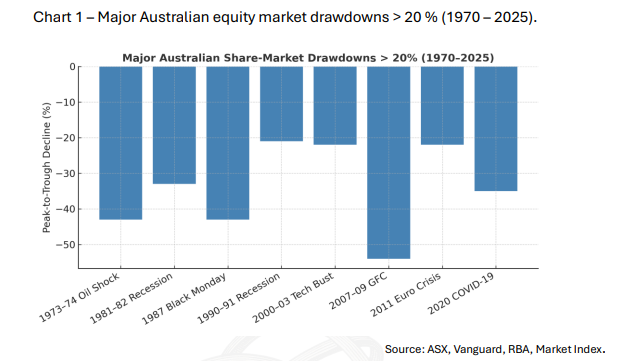
History as structure: 55 years of recurring drawdowns Australian investors often mistake the last decade of market calm for the norm. Yet history tells a different story. Over the past 55 years, the share market has experienced at least eight peakto-trough falls exceeding 20 per cent — each a test of structure, not sentiment. Every retiree today has lived through several of these events, even if memory softens their frequency.