Retirement Portfolio Resilience Perspective
Primary Pillar: Sequencing Risk Awareness
Supporting Pillars: Retirement Portfolio Construction • Behavioural Survivability
This article examines sequencing risk, widely recognised as one of the defining challenges of retirement investing, and explains why Retirement Portfolio Resilience requires a different approach to portfolio construction once investors begin drawing an income.
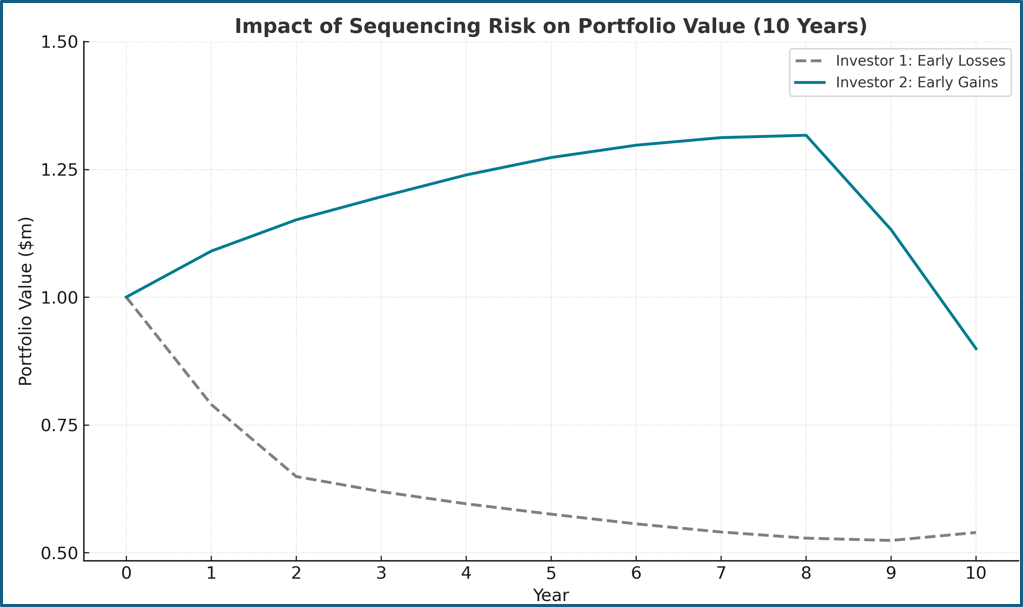
It explores how the order of investment returns can permanently influence retirement outcomes, even where long-term average returns are identical. Rather than relying on traditional diversification or market forecasts, the article explains why retirement portfolios should be designed to remain resilient across a broad range of market conditions, helping investors remain financially and emotionally invested throughout their retirement journey, regardless of the path markets take.
This article forms part of a broader body of research, educational articles and practical insights organised through the Retirement Portfolio Resilience Framework.
Executive summary
Needs: Lower-risk investors, especially retirees, want peace of mind in all markets.
Problem: “The nastiest problem in finance” (William Sharpe) is turning retirement savings into reliable income. Sequencing risk and losses early in retirement creates lasting damage.
Solution: Diversify by market scenario, falling, volatile, stable, and rising, to ensure portfolios are prepared for all conditions.
Proof: Gyrostat’s absolute return equity income funds embed protection always, delivering growth with resilience.
Introduction
Nobel Laureate William F. Sharpe once described retirement as “the nastiest problem in finance.” His point was simple but profound: unlike saving for retirement, where the challenge is to amass as much wealth as possible, the drawdown phase presents an almost impossible balancing act.
Retirees must turn a finite pool of savings into an income stream that will last a lifetime, with no certainty about how long they will live, what markets will deliver, or how much they will need to spend along the way. For advisers and their clients, this problem is not theoretical. It is immediate, personal, and unforgiving.