Retirement Portfolio Resilience Perspective
Primary Pillar: Retirement Portfolio Construction
Supporting Pillars: Resilience Across Market Environments • Behavioural Survivability
This article introduces an alternative framework for portfolio construction by encouraging advisers to blend investment managers according to the market scenarios they are designed to navigate rather than traditional investment styles alone.
It explains why effective retirement portfolio construction should recognise that different managers perform different roles across changing market environments. Rather than relying solely on style diversification, the article explores how scenario diversification can create portfolios that remain more resilient through rising, falling, volatile and stable markets. This approach supports Retirement Portfolio Resilience by aligning portfolio construction with the practical challenges investors experience throughout their retirement journey, regardless of the path markets take.
This article forms part of a broader body of research, educational articles and practical insights organised through the Retirement Portfolio Resilience Framework.
The limits of traditional diversification
Today’s challenge is not simply to hold a variety of managers, but to ensure that each one performs a role in distinct market conditions. Diversification by scenario is not about holding more funds — it’s about holding funds that respond differently when markets change regime.
The market scenario framework
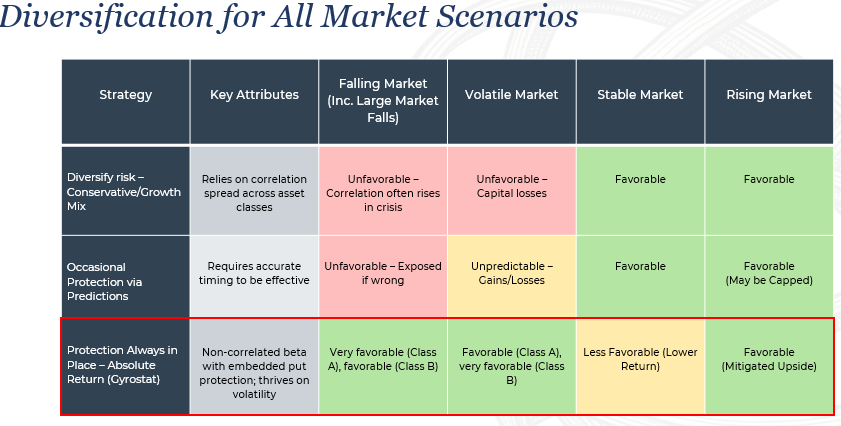
Every investment portfolio ultimately faces four dominant regimes:
1. Calm and Range-Bound Markets – Low volatility, narrow leadership, income strategies thrive.
2. Expanding Bull Markets – Broad participation, growth bias rewarded.
3. Volatility Spikes/Corrections – Correlations converge, liquidity vanishes, behaviour dominates.
4. Prolonged Bear Markets – Capital preservation, cash flow stability, and psychological resilience determine outcomes.
Each of these environments rewards a different type of manager. Instead of blending by factor exposure, advisers can design portfolios that breathe — each sleeve contributing to defense or growth as regimes evolve.